
HCN sensor
Hydrogen cyanide
Reliable real-time
data on HCN
GasPlug TECHNOLOGY | PATENTED DESIGN
Where is it found?
Hydrogen cyanide (HCN) is a colorless, highly volatile, and flammable liquid that evaporates quickly. It occurs both naturally and as a result of industrial activities.
It is found in mines, specifically, gold mining operations; combustion processes, such as vehicle exhaust, biomass burning; and at industrial applications, especially in the production of plastics (like acrylonitrile), synthetic fibers, dyes, pesticides, and electroplating.
Why measure it?
HCN is extremely toxic due to its interference with the body’s ability to use oxygen. Acute exposure can lead to headache, dizziness, nausea, confusion, rapid breathing, and loss of consciousness. High concentrations can cause seizures, respiratory failure, cardiac arrest, and death within minutes. Besides, long-term, low-level exposure can lead to neurological problems, respiratory issues, and thyroid dysfunction.
Due to its high toxicity and volatility, hydrogen cyanide is classified as a highly hazardous air pollutant and is strictly regulated in occupational and environmental settings.
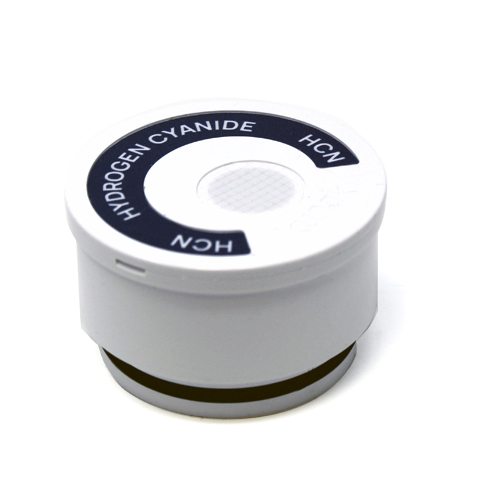
HCN cartridge
The HCN cartridge features an integrated electrochemical sensor capable of detecting both low concentrations of HCN (below 1 ppm) and higher levels, up to 50 ppm, with an accuracy of ±0.10 ppm. However, the HCN sensor exhibits significant cross-sensitivity to SO2 and NO2.
To ensure maximum accuracy when high concentrations of NO2 and SO2 are expected, it is recommended to use NO2, O3, and SO2 cartridges alongside the HCN cartridge. This setup allows the Kunak algorithm to compensate for cross-sensitivity and deliver more precise measurements.
Technical specifications
- Measurement range: concentration range measured by the sensor.
- Resolution: smallest unit of measurement that can be indicated by the sensor.
- Operating temperature range: temperature interval at which the sensor is rated to operate safely and provide measurements. (*) In type A, the temperature range can be -40 to 50 ºC with heater. More information on this version on request.
- Operating RH range (Recommended RH range): humidity interval at which the sensor is rated to operate safely and provide measurements.
- Operating life: time period during which the sensor can operate effectively and accurately under normal conditions.
- Guarantee range: concentration range covered by Kunak's guarantee.
- LOD (Limit Of Detection): measured at laboratory conditions at 20ºC and 50% RH. The limit of detection is the minimum concentration that can be detected as significantly different from zero gas concentration, based on the metric from the Technical Specification CEN/TS 17660-1:2022.
- Repeatability (measured at laboratory conditions at 20ºC and 50% RH): closeness of the agreement between the results of successive measurements of the same measure carried out under the same conditions of measurement, based on the metric from the Technical Specification CEN/TS 17660-1:2022.
- Response time: time needed by the sensor to reach 90% of the final stable value.
- Statistical metric: statistics obtained between the device hourly measurements and reference instruments for 1 to 8 months field test between -10 to +30ºC in different countries. (*) The expected error for PM10 is higher in presence of coarse particles.
- Mean Absolute Error: it is the average mean absolute error (MAE) obtained between the device hourly measurements and reference instruments for 1 to 8 months field test between -10 to +30ºC in different countries.
- Error: it is the error of the sensor at reading measurement or full scale.
- DQO-Typical U(exp): Data Quality Objetive expressed as the Expanded Uncertainity in the Limit Value obtained between hourly measurements of the device and the reference instruments for 1 to 8 months field test between -10 to +30ºC in different countries, based on the metric from the European Air Quality Directive 2008/50/EC and from the Technical Specification CEN/TS 17660-1:2022. (*) The expected error for PM10 is higher in presence of coarse particles.
- Typical intra-model variability: calculated as the standard deviation of the three sensor means in 1 to 8 months field test between -10 to +30ºC in different countries.
A, B, C, D superindex: the super indexes refer to different types of cartridges related to the same target pollutant but with different technical specifications.


Frequently asked questions
Are Kunak devices ATEX certified?
Kunak devices are designed for the perimetric monitoring of diffuse emissions or leak detection in areas not classified as ATEX.
They can be adapted to operate in explosive-risk environments, complying with ATEX Zone 1 requirements, provided the system is properly configured.
How often are the cartridges replaced and software renewed?
The lifespan of each cartridge depends on the sensor type and environmental conditions, typically ranging from 12 to 36 months. More details can be found in the catalogue.
Kunak Cloud services are renewed annually to maintain updated analysis, calibration, and data traceability.
Is the device portable or fixed?
Kunak devices can be installed on lamp posts, walls, masts, or tripods.
Thanks to their lightweight and modular design, they can be easily relocated by detaching the base and reattaching it elsewhere.
How often should the device be calibrated?
Sensors are factory-calibrated and supplied with an official calibration certificate.
To maintain accuracy, a remote calibration or adjustment is recommended every three months or after relocation or seasonal changes.
What calibration options are available?
Calibration can be performed through:
- co-location with a reference station,
- gas hood calibration with standard gas cylinders, or
- remote adjustment using historical data.
The method depends on the project requirements and available budget.
Can data be obtained locally (Modbus)?
Yes. All Kunak devices include Modbus RTU RSxx protocol, allowing local data transmission and reading without relying on internet connectivity.
How does the device communicate?
The system transmits data via cellular (4G/3G), Ethernet, Wi-Fi, or Modbus, adapting to the available network infrastructure at each site.
What is the battery life?
Devices include an internal backup battery providing between 3 and 30 days of autonomy, depending on the configuration and active sensors.
At what height should the device be installed?
Installation is recommended at a height of 3–4 metres above ground to ensure representative measurements and prevent interference or vandalism.
Does the device have internal memory?
Yes. It features high-speed internal memory capable of storing data for up to 15 days without an internet connection, ensuring data continuity.
Can meteorological probes be connected?
Yes. Kunak AIR Pro supports up to 6 meteorological probes, and Kunak AIR Lite up to 2, depending on the model.
This allows correlation between environmental variables and pollutant concentrations.
Can it be installed on a vehicle or drone for mobile monitoring?
Yes, provided the speed does not exceed 20 km/h. This ensures measurement stability and accurate environmental data capture.
Does this technology have certifications?
Sensor-based devices are not governed by a single certification.
Kunak continuously validates its devices in the field alongside independent bodies.
These tests ensure that the data complies with the European Air Quality Directive and US EPA standards.
Is the Kunak AIR Cloud platform mandatory?
Yes. Kunak AIR Cloud is essential for temperature and humidity compensation, remote maintenance, auto-diagnostics, baseline correction, data validation, and ensuring data traceability.
Can the devices be used indoors?
Yes. The devices can be used in industrial, agricultural, or logistics environments, providing accurate pollutant control even indoors.
What is the difference between the AIR Pro and AIR Lite particle sensors?
- Kunak AIR Pro: 24-channel, MCERTS-certified sensor that measures fine and coarse particles (PM1, PM2.5, PM10) with indicative measurement quality.
- Kunak AIR Lite: 5-channel, non-MCERTS sensor specialised in detecting fine particles.
How are the data integrated with third-party platforms?
Data can be automatically integrated via REST API, Modbus, or FTP, facilitating connection with external environmental or industrial management systems.
What is the difference between calibration and correction?
- Calibration adjusts the sensor’s response against a traceable reference (reference station or certified gas) to determine uncertainty.
- Correction modifies the sensor’s response without an external reference to reduce error or drift but doesn’t quantify uncertainty.
In summary, calibration uses an external reference, while correction is an internal adjustment to maintain sensor reliability. More information on page 35 of the catalogue.